Leak Detection
Pinpoint hidden water loss behind drywall, under flooring or along the pipe buried in the yard.
A bill that doubles or triples with no change in how many people live in the house deserves a closer look. Eight causes account for most of the surprises.
By the Tempe Express Plumbing team ·
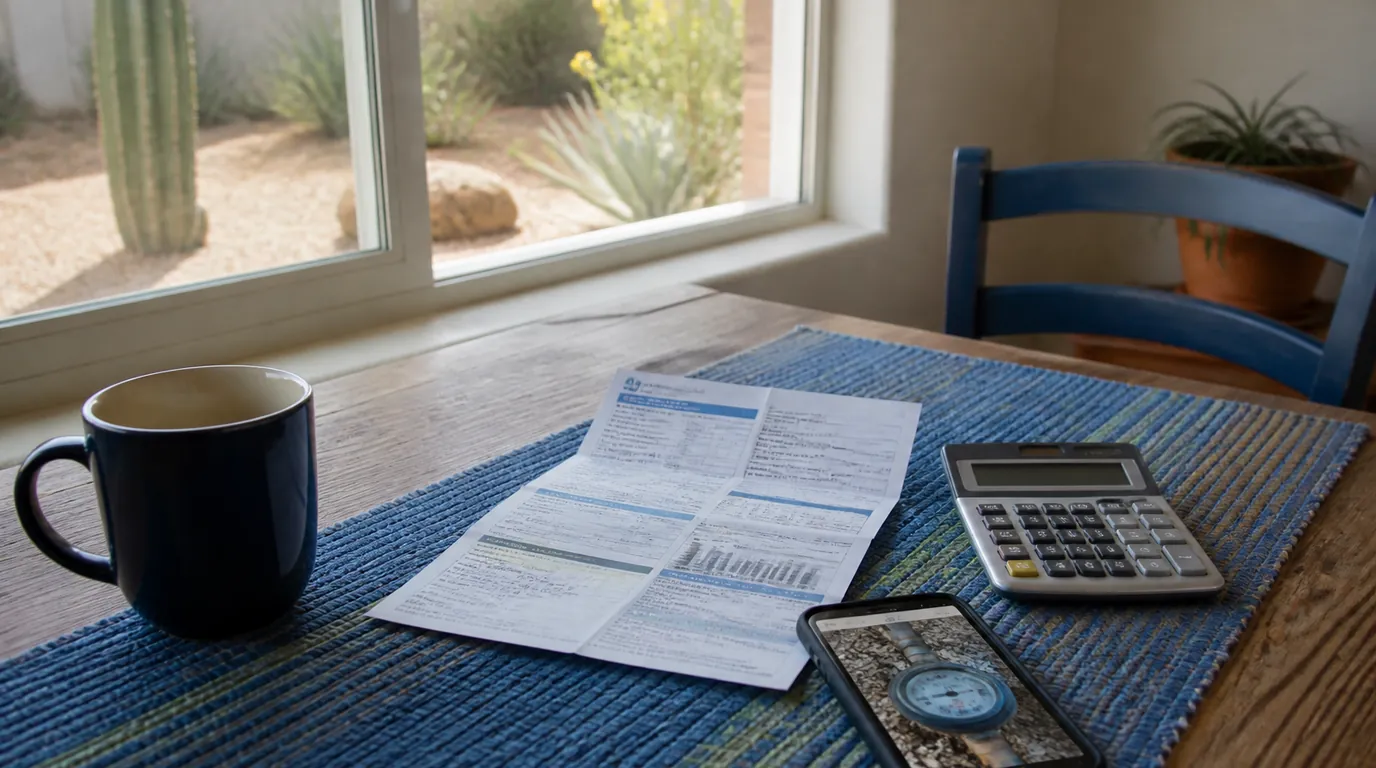
Compare the new bill against the same month a year ago instead of last month. Valley summers raise use through irrigation, evaporative cooling and pools. Read the usage number, not only the dollar amount.
If the usage jumped well beyond a normal summer rise, a leak is likely. If the dollar amount rose but the usage did not, a rate change or a billing fee may be the cause.
A worn flapper lets water slip into the bowl all day. A dripping faucet adds up too: one drip a second wastes thousands of gallons a year.
Both are cheap to fix. See toilet repair and faucet repair for what a plumber replaces.
Irrigation timers set for summer can run too long, and a stuck valve can run all day. Pools with autofill hide a leak because the valve keeps topping up.
Check timers and zones, and run the bucket test on the pool. Both are common sources of unexplained use.
A break between the meter and the house can run without a visible sign, especially in sandy or dry soil that drinks the water. A meter that moves with the house closed is the clue.
The water line repair page explains how the break is located.
Use this table to decide where to look first.
| Cause | First check | Who fixes it |
|---|---|---|
| Toilet flapper | Dye test in the tank | You or a plumber |
| Dripping faucet | Look and listen at each tap | You or a plumber |
| Irrigation or pool autofill | Timers, zones and bucket test | Landscaper or pool contractor |
| Buried service line | Meter test with the main closed | Plumber |
| Slab or wall leak | Warm spots and damp flooring | Plumber |
| Water heater or softener | Dampness around the unit | Plumber |
| Meter or billing error | Ask the utility to verify | Utility |
Pipes under the floor or in a wall can leak for weeks. Hot spots, damp flooring or the sound of running water are warning signs.
See slab leak detection if the floor feels warm.
A tank weeping at a fitting loses water slowly, and the drain pan may conceal it. A softener stuck mid-regeneration sends water out its drain line.
Check around the heater and softener for dampness. A small puddle can hide a large loss.
Meters can misread, and estimated readings can distort a bill. Ask the City of Tempe to verify the meter reading and review your usage history.
If the utility finds the meter accurate, the water went somewhere in the property.
Run the meter test: everything off, read the meter, wait twenty minutes, read again. Movement means a leak. Then close the main valve to learn whether it is inside or outside.
If you still cannot find it, leak detection pins down the location without tearing into walls.
Most utility bills show usage in units, such as hundreds of cubic feet or thousands of gallons, along with the days in the billing cycle. A longer cycle means more days of use even if the daily average stays the same. Divide usage by the number of days to get a daily figure you can compare month to month.
A gradual rise over several months often points to a slow leak or a change in habits, such as a new pool or extra landscaping. A sudden spike in one cycle suggests an event: a running toilet, a stuck irrigation valve or a broken line. The pattern helps you decide which check to run first.
Water use climbs in the hot months. Outdoor irrigation, evaporative coolers, pools and longer showers all add up. Comparing a July bill to a January bill tells you very little, which is why the same month from last year is the better benchmark.
If the same month this year is far higher with no change in the household, treat that as a signal to investigate. If it is only a little higher, a hotter summer or a new plant bed may be enough to explain it.
If the checks turn up nothing, call the utility. Ask whether the meter was read or estimated, whether the meter was replaced recently and whether it can run a test on the meter itself. Some utilities will review a bill after a repaired leak, and some offer an adjustment for a documented loss. Policies differ, so ask what documents they want.
Keep the paperwork from any repair. A written finding from a contractor, a photo of the repaired fitting and a copy of the invoice give the utility something concrete to review. A leak detection visit produces that kind of record when the source is hard to find.
Once the cause is fixed, write down the meter reading on the first day of each month for a few months. A simple log shows your normal use and makes a future jump easy to spot. Photograph the meter and keep the images with your utility bills.
A bill covering more days than usual looks higher even when daily use is normal. Check the start and end dates on the statement. If the cycle ran long or the meter was read late, the usage may be split across two periods in a way that looks odd. The utility can explain the dates.
A leak is the most common reason. A toilet flapper, a buried line or a stuck irrigation valve can all do it.
Policies vary. Ask the City of Tempe about any leak adjustment and what proof they need.
Close the main valve at the house. A meter that keeps moving puts the leak outdoors.
Same-day visits are available. Call and describe the meter behavior.
Pinpoint hidden water loss behind drywall, under flooring or along the pipe buried in the yard.
Fix or renew the supply pipe running from the street meter to your home's main shutoff.
Fix a toilet that keeps running, weeps around the base or clogs, or install a different one.
Read the meter, dye the toilet tanks and work through a few easy checks to narrow down where water is escaping.
A toilet that hisses or refills by itself pads the water bill. Work out which part is failing and whether it is a do-it-yourself swap.
One bucket, one marker and a day of patience tell evaporation apart from a real pool leak.
Call the 24/7 line and describe the meter test. A dispatcher lines up a local contractor.
Service area centered on Tempe and nearby Maricopa County cities.