Leak Detection
Pinpoint hidden water loss behind drywall, under flooring or along the pipe buried in the yard.
Most leaks hide behind walls or under floors. A few free checks narrow the search in half an hour and tell you whether the problem is inside, outside or underground.
By the Tempe Express Plumbing team ·
Turn off all faucets, pause the ice maker and softener, and confirm no appliance is cycling. Lift the meter lid and watch the low-flow indicator, usually a small triangle or dial.
Movement means water is going somewhere. Note the number, give it twenty minutes with everything off and check again. A different reading confirms a leak.
Now close the main valve at the house and watch the meter again. A dial that keeps turning puts the leak on the pipe between meter and valve, which is outdoors.
A dial that stops puts the leak inside the house. Reopen the valve and test fixtures one by one.
Worn flappers are the most common silent leak. Drop food coloring into each tank without flushing. Color that reaches the bowl within ten minutes marks a leaking flapper.
A silent toilet leak can waste hundreds of gallons in a month. A flapper costs little, and toilet repair covers anything beyond that.
Each simple test narrows the search.
| Check | What you see | What it means |
|---|---|---|
| Meter with everything off | Indicator moves | Water is flowing somewhere |
| Meter with the main closed | Still moves | Leak is outside, before the main |
| Dye in the toilet tank | Color reaches the bowl | Flapper leak |
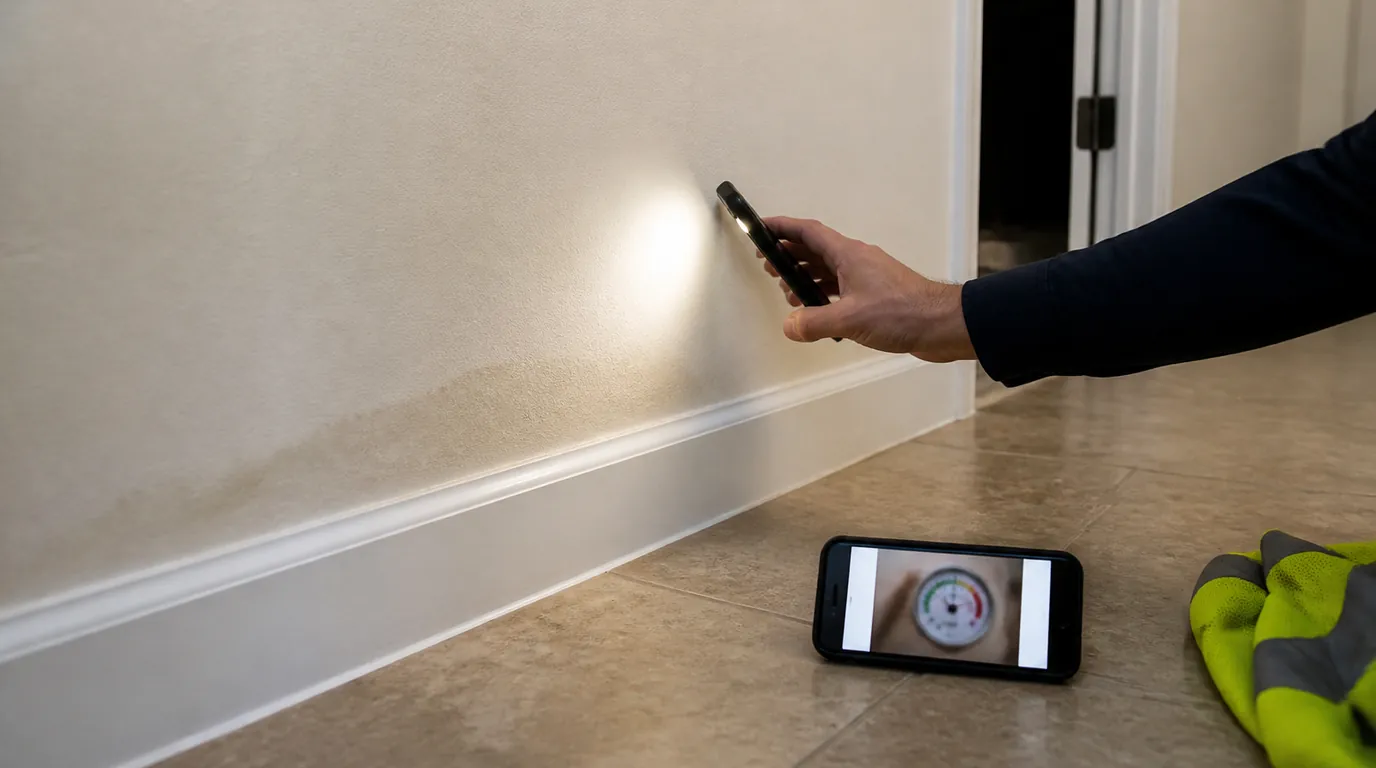
Scan for ceiling stains, blistered paint, swollen baseboards and a musty smell. Touch walls beside plumbing fixtures to check for damp or warm spots.
Check under sinks, behind the washer and around the water heater. A drip you can see is the easy leak. Water you cannot see is the reason the meter keeps moving.
Walk the route from the meter to the house. Watch for spongy soil, a lusher green stripe or a wet patch far from any sprinkler, and listen for hissing in the meter box.
A leak in the yard may be the service line, an irrigation tie-in or a hose bib. The water line repair page covers the buried pipe.
Warm spots on a floor, damp flooring and a faint sound of running water point to pipe under the slab. See slab leak detection for what comes next.
Leaks inside walls rarely show right away. Water travels along framing, so the stain is often far from the source.
If the meter still moves and nothing explains it, make the call. A contractor may pressure test sections, listen along the pipe or use a thermal camera. Methods differ, so ask what will be used.
Leak detection is the next step when your own checks come up empty.
Close the main valve if water is actively escaping. Lift belongings off wet floors, photograph the damage and write down meter readings with the times.
Tell your landlord if you rent. A written note creates a record that protects you.
A leak is easier to track when you write things down. Record the meter reading, the time, and what was running. Take a photo of the meter dial each time, since the numbers are easy to misread. A log kept over a day or two shows whether the loss is steady, which suggests a constant leak, or comes and goes, which suggests a fixture that opens under pressure.
Add short notes about odors, sounds and stains. A hiss near a wall, a damp smell in a closet or a floor that feels warm is more useful to a contractor than a general worry about the bill.
Some leaks appear only when a fixture is used. A shower valve that leaks while the water runs, a washer hose that drips under pressure or a drain joint that seeps during a flush will not move the meter at rest. Run each fixture for a few minutes while someone watches the wall or the cabinet below.
Hot water lines can leak only when the heater cycles on, because the pipes expand with heat. If a stain grows after the morning showers, hot lines are a good place to start.
Irrigation systems add another layer. Valves can stick open or leak at a zone box, and the loss shows up only when the controller runs. Switch the system off at the controller and recheck the meter before you assume the leak is inside the house.
A contractor can do things a homeowner cannot. Isolating the house at a different valve, pressure testing a single line, using sound-based listening equipment or a thermal camera, and tracing a pipe through a wall all narrow the search to a small area. That keeps the repair small and protects the finish.
If you have already found the meter moving and ruled out toilets, say so when you call. The dispatcher can match you with a contractor who handles leak detection and can plan the visit around the clues you gathered.
In a shared building, the meter you read may serve more than one unit, which makes a simple meter test less reliable. Ask the property manager whether each unit has its own submeter and where the shutoff for your unit sits. A shutoff valve under a sink or behind an access panel often isolates one unit without affecting the rest.
Report any suspected leak to the manager in writing the same day. Include photos, the meter or submeter reading and the time you noticed the problem. A clear record protects you if a dispute arises later about who caused the damage.
Watch the meter with everything off. If the indicator moves, water is flowing. A bill jump is another clue.
Yes. Leaks under slabs, in walls and in buried lines can run quietly until a stain or a bill gives them away.
Yes. A leaking flapper can waste hundreds of gallons a month.
A plumber with leak detection methods. Ask the dispatcher about same-day visits.
Pinpoint hidden water loss behind drywall, under flooring or along the pipe buried in the yard.
Find a pressurized pipe leaking under the foundation and weigh the ways to reach it.
Fix or renew the supply pipe running from the street meter to your home's main shutoff.
Eight ordinary reasons a Tempe water bill climbs, plus how to separate a leak from heavy use.
A toilet that hisses or refills by itself pads the water bill. Work out which part is failing and whether it is a do-it-yourself swap.
Locate and test your shutoff before an emergency. This guide covers finding it, closing it and what to do afterward.
Figures and statements on this page that come from outside references are listed here.
Call the 24/7 line and describe what you found. A dispatcher lines up a local contractor.
Service area centered on Tempe and nearby Maricopa County cities.