Low Water Pressure Repair
Test the pressure, then fix the aerator, valve, regulator or supply pipe that is starving your taps.
Trickle instead of flow at one faucet is a small problem. Trickle instead of flow at every tap is a bigger one. The pattern points to the cause, and a cheap gauge confirms it.
By the Tempe Express Plumbing team ·
First decide where pressure is low. A weak faucet or shower alone implicates that fixture, while weakness everywhere implicates the supply side.
Weak hot water with normal cold is its own clue and points to the heater or its valves.
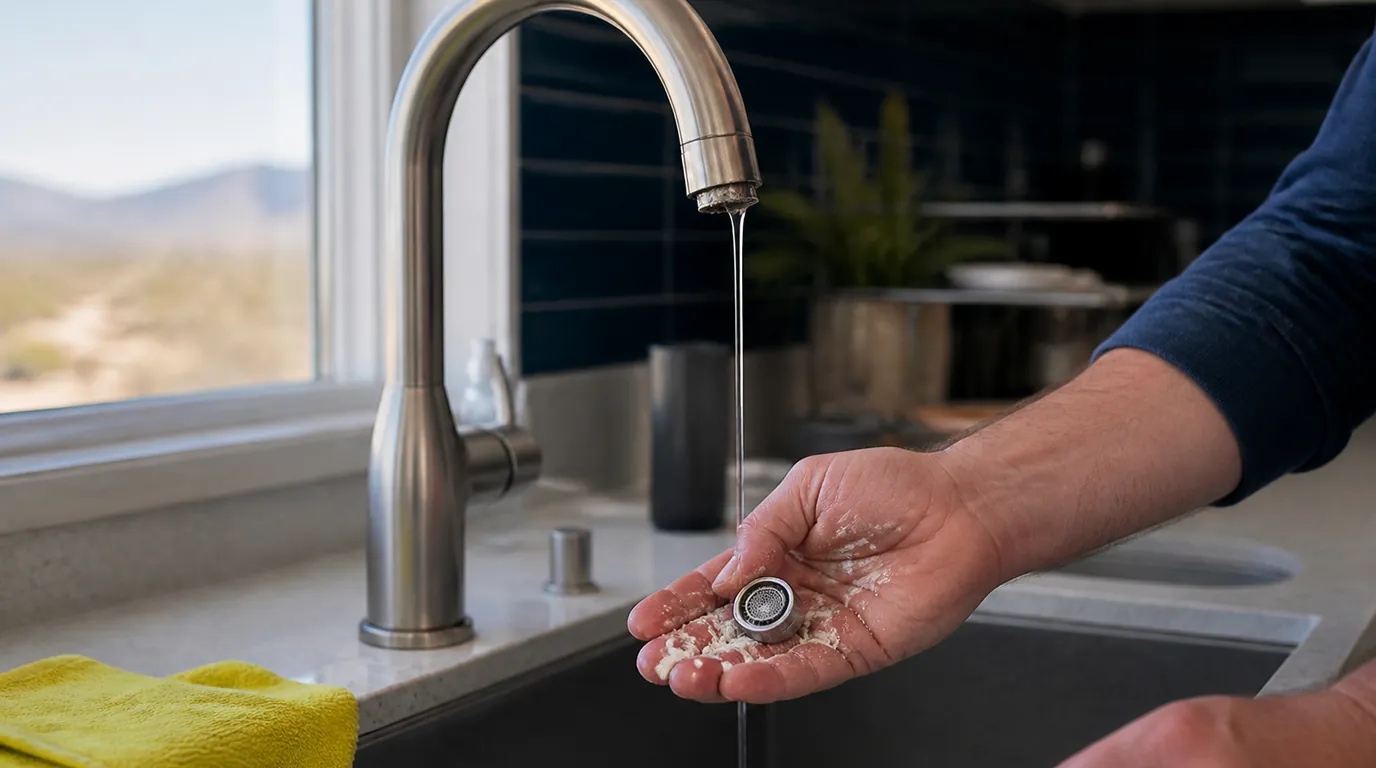
Mineral grit collects in aerators and showerheads and chokes flow. Unscrew the part, rinse it and soak it in vinegar if it is crusty.
This fix takes five minutes. If flow returns, you are done. If not, the problem is deeper in the line.
Screw a pressure gauge onto an outdoor spigot, with no water running anywhere, and read the static pressure. Run a tap and read it again. A big drop under load means a restriction.
Most homes do well in a middle range. Very high pressure strains fixtures, and very low pressure frustrates showers. Ask a plumber what range suits your fixtures.
Many houses have a pressure-reducing valve by the main. When it fails, pressure may sag or spike, and a noisy house with fixtures that wear out often hints at a bad regulator.
Replacement is a common, modest job for a plumber.
Match what you see to the likely cause.
| Symptom | Likely cause | First step |
|---|---|---|
| A single tap runs weak | Clogged aerator or cartridge | Clean the aerator |
| Hot side only is weak | Heater valve or sediment | Check the heater shutoff |
| All taps are weak | Regulator, main valve or service line | Test with a gauge |
| Meter turns with the house off | Leak ahead of the house | Close the main and look again |
After plumbing work, a main or meter valve is sometimes left partly closed. Confirm the house main is fully open, and look at the meter-box valve as well.
A gate valve that is half open throttles the whole house. It is an easy thing to miss.
Galvanized steel corrodes from within and narrows over decades, and copper can scale in mineral-heavy water. Either one restricts flow.
If the house has old steel pipe, low pressure is often the first symptom. See repiping for what replacement involves.
A leak in the service line steals pressure before the water reaches the house. A meter that moves with everything off supports that idea. Read water line repair for the next step.
Hidden leaks in walls and slabs cause the same symptom. Leak detection tests for them.
Call if pressure drops at every tap, the meter runs with the house off, or the gauge shows a swing the regulator should not allow. Tell the dispatcher your gauge reading, if you took one.
For one weak fixture, replacing the aerator or cartridge is often enough.
Most homes run best between roughly 40 and 80 pounds per square inch at the hose bib. Below that range, showers feel weak and appliances fill slowly. Above it, fittings, hoses and the water heater wear faster, and pipes may knock when a valve closes. A cheap gauge that screws onto an outdoor faucet gives a reading in under a minute.
Take the reading with every tap and appliance off, and again while a large fixture runs. A big drop under load means the supply or the pipe is restricted. A steady low reading with nothing running points back toward the regulator or the supply itself.
Pressure in a neighborhood is partly set by the utility and the elevation of the system. A house at the end of a long run, or one on a rise, may see lower pressure at peak hours. If a neighbor reports the same drop at the same time each evening, the cause may be on the utility side of the meter rather than in your pipes.
Call the utility if the meter is at the center of the problem. Ask whether any work or flushing is happening nearby, and whether they can check pressure at the meter. A contractor cannot fix an issue on the street side, but a record of when it happens makes the conversation easier.
Work from the cheapest check to the costliest. Clean aerators and showerheads first. Open the main and meter valves fully. Test the regulator with a gauge. Only then look at old pipe or a hidden leak, which take more time and money to confirm.
Keep notes as you go so you can tell the contractor what you already ruled out. A person who says the aerators are clean, the valves are open and the gauge reads 35 psi gives the dispatcher a head start. Pages like low water pressure repair and water line repair explain what comes next if the supply pipe itself is restricted.
If only the hot side is weak, the heater is a suspect. Sediment can clog the outlet, a partly closed valve on the heater restricts flow, and old dip tubes can break apart and block the line. A flush of the tank, done carefully, often restores flow. Turn off the power or gas first, and wait for the water to cool.
A house with a softener or filter may also lose pressure if a cartridge is clogged or a bypass valve is set wrong. Put the unit in bypass and test again. If pressure recovers, the filter media needs service.
Before you call, jot down which fixtures are weak, the gauge reading at the hose bib and the time of day it is worst. Note any recent work on the house or the street. These details help the dispatcher choose the right visit and help the contractor arrive with the right parts.
Usually a clogged aerator or a worn cartridge. Clean the aerator first.
A failing regulator, a partly closed main, scale in old pipe or a service line leak are the main causes.
Attach a gauge to an outdoor spigot and read it with the water off, then with a tap running.
Yes. A leak in the service line often shows up as a pressure drop and a moving meter.
Test the pressure, then fix the aerator, valve, regulator or supply pipe that is starving your taps.
Fix or renew the supply pipe running from the street meter to your home's main shutoff.
Swap aging supply piping throughout the house when patches keep failing.
A thud when a faucet or appliance valve shuts is water hammer. Learn the causes and inexpensive remedies.
Each material has a place in Valley homes. Compare them on cost, durability, sunlight exposure and repair options.
Read the meter, dye the toilet tanks and work through a few easy checks to narrow down where water is escaping.
Call the 24/7 line and share your gauge reading. A dispatcher lines up a local contractor.
Service area centered on Tempe and nearby Maricopa County cities.