Water Filtration Installation
Fit a whole-house or under-counter filter for taste, smell or grit.
Scale on fixtures, spots on glass and a heater full of sediment point to mineral-heavy water. A softener addresses hardness. A broken softener just wastes salt.
Tell the dispatcher about the symptoms, and a contractor is lined up.
Before buying a softener, learn how hard your water is. Tempe publishes results in its annual water quality report. A home test kit gives a rough check at the tap.
The city notes there is no federal or state standard for hardness, so the choice is yours.
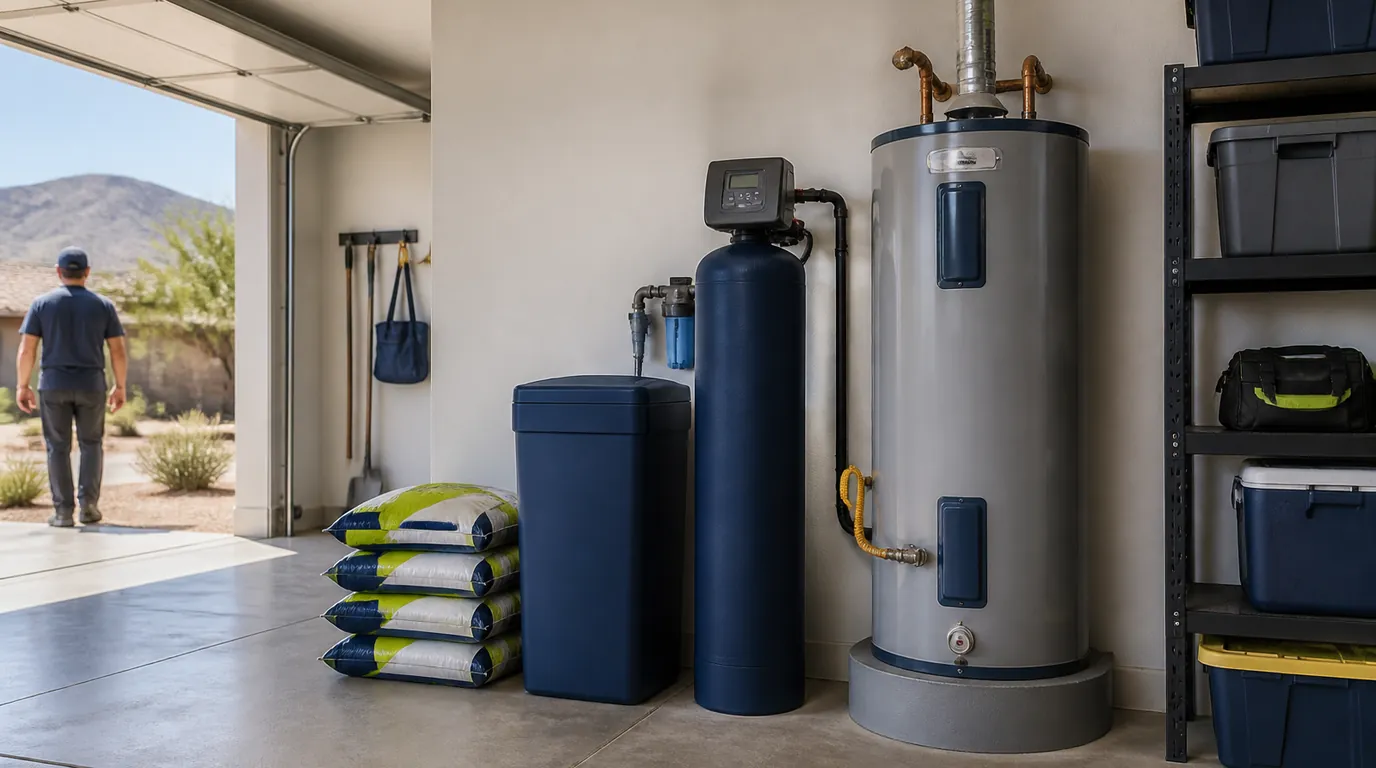
A softener installs on the main supply after the shutoff, with a bypass valve, a drain connection and a power outlet. Salt is added to a brine tank.
Local rules may limit where regeneration water can go. Ask the contractor about drain setup.
The City of Tempe says Salt River water has more dissolved solids and chlorides, and Verde River water has more hardness. The mix at your tap shifts through the year.
Check the water quality report for the figures, then decide whether you need a softener, a filter or both.
Cost depends on capacity, features and installation.
Ask for the ongoing cost, not only the install price.
Frequent faults include a stuck valve, a failed control head, resin loss and a clogged injector. A softener that stops regenerating or leaves hard water at the tap needs a diagnosis.
If a unit is old and failing in several ways, replacement may beat repair.
A salt-based softener removes hardness minerals. A salt-free conditioner changes how minerals behave but does not remove them. A filter handles chlorine taste and particles. Choosing between them starts with what bothers you, not what is for sale.
Frequent faults include a stuck valve, a failed control head, a clogged injector and a brine tank that has bridged with salt. A softener that never regenerates leaves you with hard water and an unnecessary salt bill.
A softener valve that leaks, a bypass that is stuck or a drain line that backs up can all be fixed. Ask the plumber to inspect the connections, since scale can build around old fittings.
If your unit was disconnected during a remodel, a plumber can reinstall it and test the setup. Mention what was moved or replaced.
Check the brine tank every month. Keep salt above the water level, and break up any crust or bridge that forms. Clean the tank once a year, and look at the settings on the control head to make sure the hardness and regeneration values match your water.
Fit a whole-house or under-counter filter for taste, smell or grit.
Clear mineral scale from an on-demand heater, chase down fault codes, or install a new one.
Remove the dead tank and set a new heater matched to household size, fuel supply and available space.
It depends on your hardness and what bothers you. Check the city's water quality report and look at your fixtures.
Often. Give the brand and model, and describe what it does. The dispatcher matches a contractor.
No. A softener addresses hardness. A filter handles chlorine taste and odor.
Use and water hardness decide it, so peek into the brine tank every so often.
The dispatch line never closes. If the softener leaks, switch it to bypass or close its supply valve, then call.
Pricing depends on the unit, the plumbing layout and the drain setup. The dispatcher gives a clear quote before work begins.
Often yes. Give the brand and describe the fault, and the dispatcher matches a contractor.
Ask on the call. A plumber can check the valve, the bypass and the drain, and report on condition.
No. A softener removes hardness. A filter handles chlorine and particles.
Figures and statements on this page that come from outside references are listed here.
Phone the dispatch line and a local contractor will be arranged.
Service area centered on Tempe and nearby Maricopa County cities.