Water Heater Installation & Replacement
Remove the dead tank and set a new heater matched to household size, fuel supply and available space.
Tankless units save space and give hot water on demand, but minerals build up inside the heat exchanger. Descaling keeps the unit running as designed.
Tell the dispatcher the make if you know it, and a contractor is lined up.
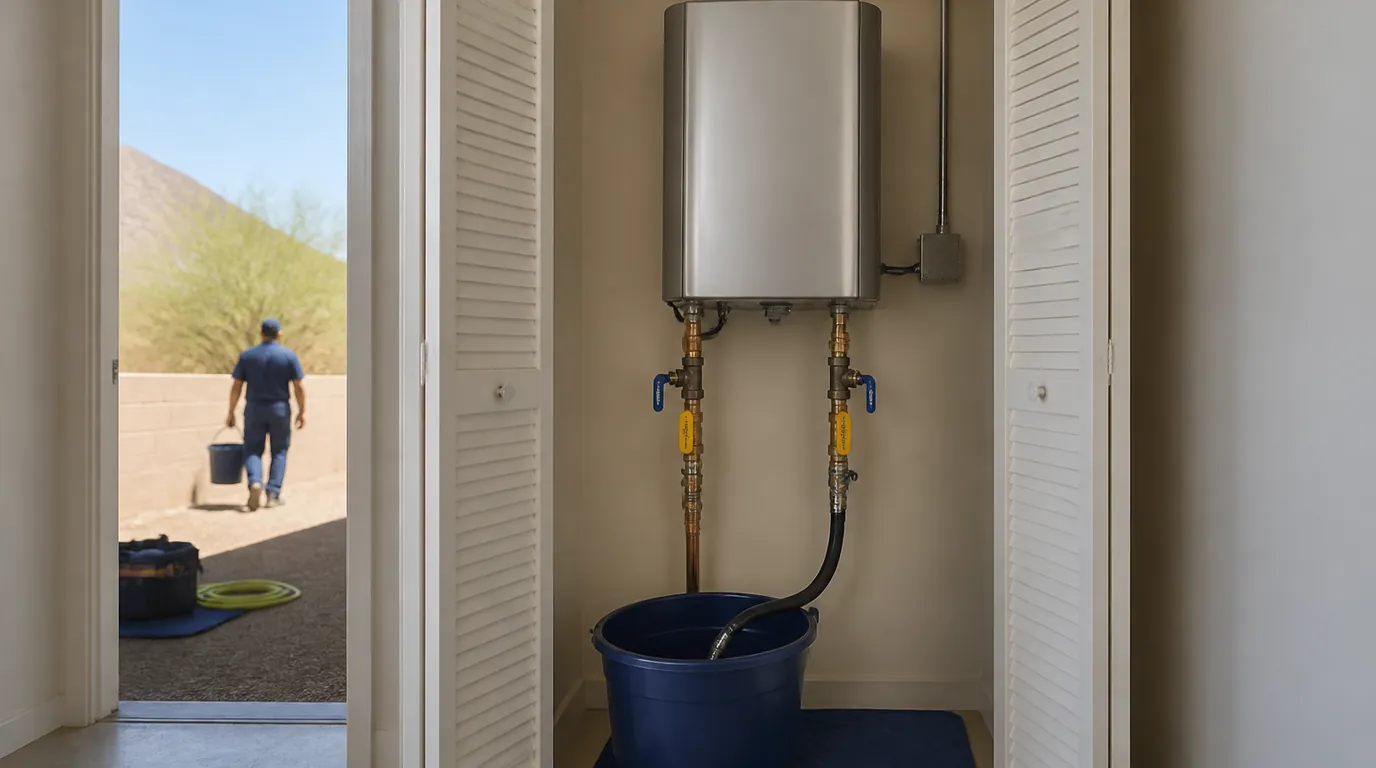
A descale circulates a mild acid solution through the heat exchanger to dissolve mineral buildup, after which the unit is flushed and its filter cleaned.
Manufacturers often recommend regular flushing. Check your manual and ask the contractor how often your water requires it.
Common repairs include replacing flow sensors, igniters, fans and temperature sensors. Error codes point to the area, but a technician confirms the cause.
If a heat exchanger has failed from scale or age, replacing the unit may cost less than the part.
Pricing depends on the unit and the problem.
Ask whether isolation valves are installed. They make future flushes easier.
Tempe's water draws on the Salt and Verde river systems. The city notes that Verde water is harder, which is why mineral buildup is a regular concern in the Valley.
Service records help. Keep notes on when the unit was last flushed.
Mineral-heavy water shortens the life of a heat exchanger. A softener or scale filter can help, depending on the water and the unit.
Tempe publishes hardness figures in its annual water quality report. Check it before choosing treatment.
Tankless units give clear hints that scale is building.
The plumber closes the isolation valves, connects hoses to the service ports and circulates a descaling solution for a set time. The unit is rinsed, the inlet filter is cleaned and the unit is returned to service. Without service valves, the plumber installs them first.
Ask whether the quote includes the isolation valves, the descaling solution and a test of temperature and flow afterward.
A flush fixes scale. It does not fix a failed sensor, a worn fan or a cracked heat exchanger. Error codes help the plumber narrow the cause, but a test confirms it. If the exchanger has failed, compare the repair to the cost of a new unit.
Fuel type matters. Gas models need vent checks. Electric models need breaker and element checks. Tell the dispatcher which you have.
Not every contractor works on every brand. If you own a specific model, give the make and the error code on the call. If the unit is near the end of its life, ask for a replacement quote as well.
Remove the dead tank and set a new heater matched to household size, fuel supply and available space.
Put in a softener or get a stalled one cycling and making soft water again.
Troubleshoot cold showers, tank leaks, rumbling and pilot or heating element faults.
Follow the manufacturer's schedule and adjust for your water. Hard water calls for more frequent service.
Codes flag ignition, flow or temperature faults. A technician reads the code and then tests for the cause.
It can when demand exceeds its flow rate, for example with several fixtures running at once.
Ask on the call and give the make and model. The dispatcher matches a contractor.
Call at any hour. A unit that leaks or smells of gas should be shut off first, and timing depends on the contractor and parts.
Pricing depends on the model, valves and scale level. The dispatcher gives a clear quote before work begins.
Yes. A flush clears scale from the heat exchanger and cleans the inlet filter, and the schedule depends on the manufacturer and your water.
Same-day visits are available. Give the make and any error code.
If the unit is relatively new and the fault is a sensor or igniter, yes. An old unit with a cracked exchanger may not be.
Figures and statements on this page that come from outside references are listed here.
Call the 24/7 line and give the model if you have it. A dispatcher lines up a local contractor.
Service area centered on Tempe and nearby Maricopa County cities.